(Dr. Gus Lorenz)
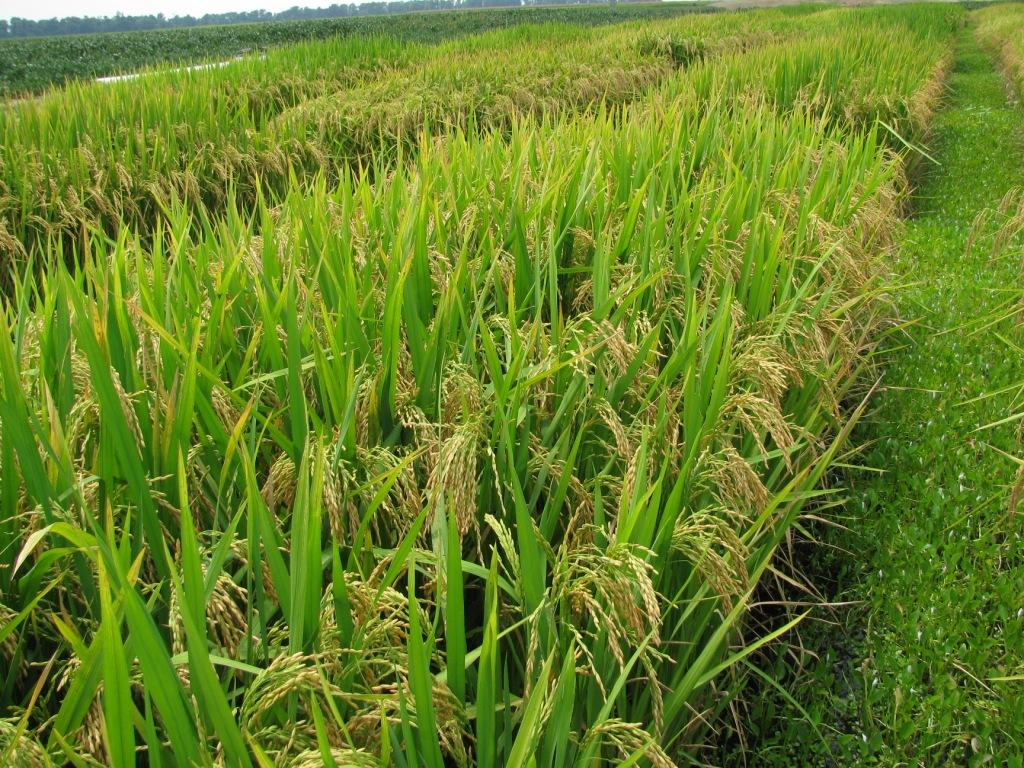
We are observing large numbers of stink bugs moving into rice fields that are in the 3rd and 4th week of heading. We are observing numbers as high as 4x threshold. This is occurring in all rice growing regions
of the state. These are fields where the rice panicles/ seed are in the milk or soft dough stage. Stink bug feeding at this time can cause "pecky rice", which can result in significant discounts on the price received when the rice is sold.
Rice is not safe from damage until it reaches the hard dough stage. If the rice grain is still soft and pliable or can be squeezed between your fingers, it is still susceptible to damage. In many cases the oldest part of the panicle is hard dough but the base of the panicle is still soft dough. This is a field-by-field call. Just remember the discount for peck can be severe and best avoided.
The threshold for rice stink bugs is one per sweep. Take 10 sweeps in several locations in the field if you are averaging 10 stink bugs per 10 sweeps you need to make an insecticide application. Recommended products are pyrethroids such as Karate or Mustang Max or methyl parathion. Do not release the flood water within 7 days of application. Also be advised that when sampling during the hot part if the day, stink bugs move down in the plant and sampling at this time may not reflect the true number of stink bugs. Sampling is most effective early in the morning and late in the evening when the bugs are out on the panicles. Sweepnets are much more effective than "visual observations".
Wednesday, August 11, 2010


Thursday, August 5, 2010
RICE FIELD DAY NEXT WEEK!

Is it time to drain my rice yet?
I realize that several farmers have already started draining, and even harvesting in some cases. However, I thought this might be helpful in light of the heat and drought conditions we are currently experiencing. Farmers are always interested in when I can quite spending money on irrigation and begin to prepare for harvest. This has been especially true this year in light of the high input costs already paid out for this crop. For the majority of the rice acreage, we recommend draining 25-28 days after 50% heading. This generally corresponds to the time when the heads have all turned down and most of the panicles have changed color at least half way down the panicle. The photos below illustrate what rice typically looks like 25 days after 50% heading. The three panicles in the second photograph were taken from the plot in the first photograph.


Research varies on the effects of earlier draining but some studies have reported yield losses as much as 10% when drained too early. Remember in this heat, soils dry quickly. Don’t over estimate the amount of time is will take for the soils to dry. One option to help reduce pumping costs is to establish a good flood 14 days after 50% heading and then let the field dry down. This works for some growers but others have indicated that removing levee gates is too difficult if the fields dry out before drain time. In hot, dry years like this year, you still may need to flush through the fields if you don’t get any rainfall to help the crop to mature. If you routinely must rut the field in order to get the rice harvested on time because the fields do not dry enough, earlier draining is a feasible option. This is usually the case on most heavy clay fields.

Research varies on the effects of earlier draining but some studies have reported yield losses as much as 10% when drained too early. Remember in this heat, soils dry quickly. Don’t over estimate the amount of time is will take for the soils to dry. One option to help reduce pumping costs is to establish a good flood 14 days after 50% heading and then let the field dry down. This works for some growers but others have indicated that removing levee gates is too difficult if the fields dry out before drain time. In hot, dry years like this year, you still may need to flush through the fields if you don’t get any rainfall to help the crop to mature. If you routinely must rut the field in order to get the rice harvested on time because the fields do not dry enough, earlier draining is a feasible option. This is usually the case on most heavy clay fields.
WHAT ABOUT "SALTING" MY RICE?
Sodium chlorate is commonly used to desiccate green foliage and weeds present in rice fields to increase harvest efficiency. The general guidelines are to apply sodium chlorate at 3 to 6 pounds a.i. per acre when rice grain is near 25 percent moisture and harvest within 3 to 7 days after application. Although sodium chlorate is typically used to dessicate the vegetation, grain moisture is also reduced. Research suggests that when used properly sodium chlorate does not reduce head rice yield. However, application of sodium chlorate at 6 pounds a.i. per acre significantly reduced grain moisture by 2 to 5 percent within four days after application. Head rice yields may decline if grain moisture drops below 15 percent before the grain is harvested. Thus, sodium chlorate should be applied to rice that is between 18 and 25 percent moisture with timely harvest following application. Use of sodium chlorate on seed production fields is sometimes needed. Research has shown that sodium chlorate does not influence germination of the resulting seed.
 Desiccation of rice foliage is noticeable within 36 hours after application, especially when temperatures are high. The photo above was taken less than 48 hours after application. The treated plots are very apparent and dessication was very effective. Sodium chlorate may reduce head rice and grain yield if applied too early, before grain fill is complete. Do not apply to rice when the moisture is above 25%. Growers should exercise caution when considering sodium chlorate application to fields with uneven maturity to avoid yield and quality losses.

August 5 Rice Crop Condition and Progress
As of August 2, the USDA reports that 74% of the crop is heading and a couple of fields have been harvested. This compares to 57% heading last week, 28% this time last year, and a 5-year average of 39% for this week. Arkansas rice does not normally begin heading in June nor is it normally harvested in July. The first rice harvested in Arkansas that I am aware of was on July 30. Harvest has begun in some areas this week and will get going strong in about 2 weeks. As of August 2, 18% of the crop is reported to be in excellent condition, 44% good, 31% fair, 6% poor, and 1% very poor.
Average temperatures for the week ending August 2 ranged from 0 to 5 degrees above normal. The temperatures ranged from a low of 68 degrees at Gilbert and Calico Rock to a high of 104 degrees in Camden, with several locations exceeding 100 degrees. Rainfall for the week ending August 2 ranged from none at several locations to a high of 3.2 inches at Hot Springs. Overall, soil moisture supplies were 13% very short, 56% short, 29% adequate, and 2% surplus. The extended heat and dry weather have caused a significant strain on the irrigation capacity across the Delta. Rice fields have spots (some large, some small) that are burning because the well is unable to keep up with the dry weather. Officially, most of Eastern and Southern Arkansas is “moderate drought”, parts of Southeast Arkansas is in “Severe drought”.
Average temperatures for the week ending August 2 ranged from 0 to 5 degrees above normal. The temperatures ranged from a low of 68 degrees at Gilbert and Calico Rock to a high of 104 degrees in Camden, with several locations exceeding 100 degrees. Rainfall for the week ending August 2 ranged from none at several locations to a high of 3.2 inches at Hot Springs. Overall, soil moisture supplies were 13% very short, 56% short, 29% adequate, and 2% surplus. The extended heat and dry weather have caused a significant strain on the irrigation capacity across the Delta. Rice fields have spots (some large, some small) that are burning because the well is unable to keep up with the dry weather. Officially, most of Eastern and Southern Arkansas is “moderate drought”, parts of Southeast Arkansas is in “Severe drought”.
Monday, July 26, 2010
IDENTIFYING BACTERIAL PANICLE BLIGHT AND NECK BLAST OF RICE
(by Whitney Ginn and Rick Cartwright)
We are currently observing widespread neck blast of rice in Arkansas for the third year in a row, largely on the rice varieties CL 151, CL 261, Francis, Jupiter and at lower levels on Wells and CL 142. The blast problem was likely increased by frequent May rains that resulted in a lot of leaf blast in the state, followed by erratic drought patterns that made keeping a deep, consistent flood on rice fields difficult.
Recently, we also began noticing symptoms of bacterial panicle blight developing in fields of CL 261 and CL 181, and at low levels in CL 151, CL 142, CL 111 and Francis. Weather patterns in recent weeks have included very warm nights with high humidity, conditions that favor this disease. We are hopeful that bacterial panicle blight will stay at low levels, but early observations concern us that this may be a panicle blight year like we saw in 1995, 1998, and 2001 on Bengal and a few other varieties.
Distinguishing between bacterial panicle blight and early neck blast symptoms is not difficult, with some practice. The following photos illustrate the diagnostic differences.
Bacterial Panicle Blight: Note the cluster pattern of early infected heads (A), with a mixture of tan, green, brownish or gray kernels – but a green rachis (panicle branches)(B). At least some kernels will have a distinctly brown base (C) and inside the small kernel will be aborted and rotted at the base.


Neck blast of rice: Note the “white heads” in affected field (D) and the dark lesion on the node below the infected panicle (E); dark lesions may also appear in the rachis, resulting in blighted spikelets or kernels; earlier lesions of blast can be found on leaves, collars and lower stem nodes (G); spores can be easily observed at 100X if a microscope is available (F).


We are currently observing widespread neck blast of rice in Arkansas for the third year in a row, largely on the rice varieties CL 151, CL 261, Francis, Jupiter and at lower levels on Wells and CL 142. The blast problem was likely increased by frequent May rains that resulted in a lot of leaf blast in the state, followed by erratic drought patterns that made keeping a deep, consistent flood on rice fields difficult.
Recently, we also began noticing symptoms of bacterial panicle blight developing in fields of CL 261 and CL 181, and at low levels in CL 151, CL 142, CL 111 and Francis. Weather patterns in recent weeks have included very warm nights with high humidity, conditions that favor this disease. We are hopeful that bacterial panicle blight will stay at low levels, but early observations concern us that this may be a panicle blight year like we saw in 1995, 1998, and 2001 on Bengal and a few other varieties.
Distinguishing between bacterial panicle blight and early neck blast symptoms is not difficult, with some practice. The following photos illustrate the diagnostic differences.
Bacterial Panicle Blight: Note the cluster pattern of early infected heads (A), with a mixture of tan, green, brownish or gray kernels – but a green rachis (panicle branches)(B). At least some kernels will have a distinctly brown base (C) and inside the small kernel will be aborted and rotted at the base.

Neck blast of rice: Note the “white heads” in affected field (D) and the dark lesion on the node below the infected panicle (E); dark lesions may also appear in the rachis, resulting in blighted spikelets or kernels; earlier lesions of blast can be found on leaves, collars and lower stem nodes (G); spores can be easily observed at 100X if a microscope is available (F).
Tuesday, July 20, 2010
July 20 Rice Crop Condition and Progress
As of July 19, the USDA reports that 37% of the crop is heading. This compares to 16% last week, 9% this time last year, and a 5-year average of 9% for this week. Arkansas rice does not normally begin heading in June but we saw that happen in 2010. The crop was seeded earlier and we had 8 straight weeks with temperatures above normal. Thus, the crop has developed much sooner than normal. As of July 19, 21% of the crop is reported to be in excellent condition, 44% good, 30% fair, and 5% poor.
Average temperatures for the week ending July 19 were near to slightly above normal. The temperatures ranged from 1 degrees below normal at Newport to 4 degrees above normal at several locations. The temperatures ranged from a low of 68 degrees at several locations to a high of 100 degrees in Little Rock and El Dorado. Rainfall for the week ending July 12 ranged from none at Hope and El Dorado to a high of 7.0 inches at Fayetteville. Overall, soil moisture supplies were 5% very short, 29% short, 59% adequate, and 7% surplus. The extended heat and dry weather have caused a significant strain on the irrigation capacity across the Delta. Rice fields have spots (some large, some small) that are burning because the well is unable to keep up with the dry weather. Officially, most of Eastern and Southern Arkansas is “abnormally dry”, which is effectively a mild drought. These data are collected as of Friday and do not reflect the rainfall that has occurred in much of Eastern Arkansas.
Average temperatures for the week ending July 19 were near to slightly above normal. The temperatures ranged from 1 degrees below normal at Newport to 4 degrees above normal at several locations. The temperatures ranged from a low of 68 degrees at several locations to a high of 100 degrees in Little Rock and El Dorado. Rainfall for the week ending July 12 ranged from none at Hope and El Dorado to a high of 7.0 inches at Fayetteville. Overall, soil moisture supplies were 5% very short, 29% short, 59% adequate, and 7% surplus. The extended heat and dry weather have caused a significant strain on the irrigation capacity across the Delta. Rice fields have spots (some large, some small) that are burning because the well is unable to keep up with the dry weather. Officially, most of Eastern and Southern Arkansas is “abnormally dry”, which is effectively a mild drought. These data are collected as of Friday and do not reflect the rainfall that has occurred in much of Eastern Arkansas.
Subscribe to:
Posts (Atom)